European airport traffic grows 3.9% in July and 3.1% in August 2026
European airport passenger traffic grew 3.9% in July and 3.1% in August 2026, accelerating from a weak second quarter.
Passenger traffic across European airports grew by 3.9% in July and 3.1% in August 2026 compared to the same months last year. This marked an acceleration from the constrained second quarter, which saw only 1.3% growth due to war in the Middle East.
Airports outside the EU+ market recorded the strongest regional growth at 6.6% in July and 6% in August. Within the EU+ bloc, growth was more moderate at 3.4% in July and 2.5% in August. Industry body ACI EUROPE attributed much of the growth at smaller airports to low-cost carrier expansion and new transatlantic routes. Its Director General, Olivier Jankovec, stated that the summer rebound shows air travel demand remains resilient despite geopolitical tensions, deteriorating macroeconomic conditions, supply constraints, and higher air fares.
National and regional performance variations
Significant differences in growth rates emerged between countries. Slovakia saw the largest national increase in August with 61% growth. Slovenia, Estonia, Hungary, and Malta also posted strong double-digit gains.
Conversely, several markets contracted. Iceland experienced the largest decline at 9.3% lower traffic in August. Austria fell by 6%, France by 1.7%, and Cyprus by 1.5%. Norway and Germany saw smaller declines of 0.3% and 0.2% respectively. Among the largest EU+ markets, Italy grew 5.2% and Spain 4.7%, while the UK managed only 0.9% growth.
In non-EU+ markets, North Macedonia led with 34.8% growth in August. Montenegro followed with 28.6% and Albania with 20.7%. Israel grew 19.5%, Armenia 14.2%, Moldova 12.6%, and Uzbekistan 10.5%. The largest non-EU+ market, Türkiye, recorded 4.4% growth.
Individual airport performance varied widely. The table below shows selected airport growth rates for August 2026.
| Airport | Passenger Growth (August 2026) |
|---|---|
| Bratislava (BTS) | 75.9% |
| Trapani (TPS) | 52.3% |
| Podgorica (TGD) | 47.6% |
| Skopje (SKP) | 34.8% |
| Palermo (PMO) | 32.3% |
| Tirana (TIA) | 20.7% |
| Tel Aviv (TLV) | 19.5% |
| Tashkent (TAS) | 16.6% |
| Ankara (ESB) | 13.3% |
| Venice (VCE) | 12.7% |
Small airports, defined as those handling under 1 million passengers annually, grew 4.2% in August. Despite this growth, their traffic remained 25.5% below pre-pandemic levels from August 2019.
Hub airport dynamics and size-based trends
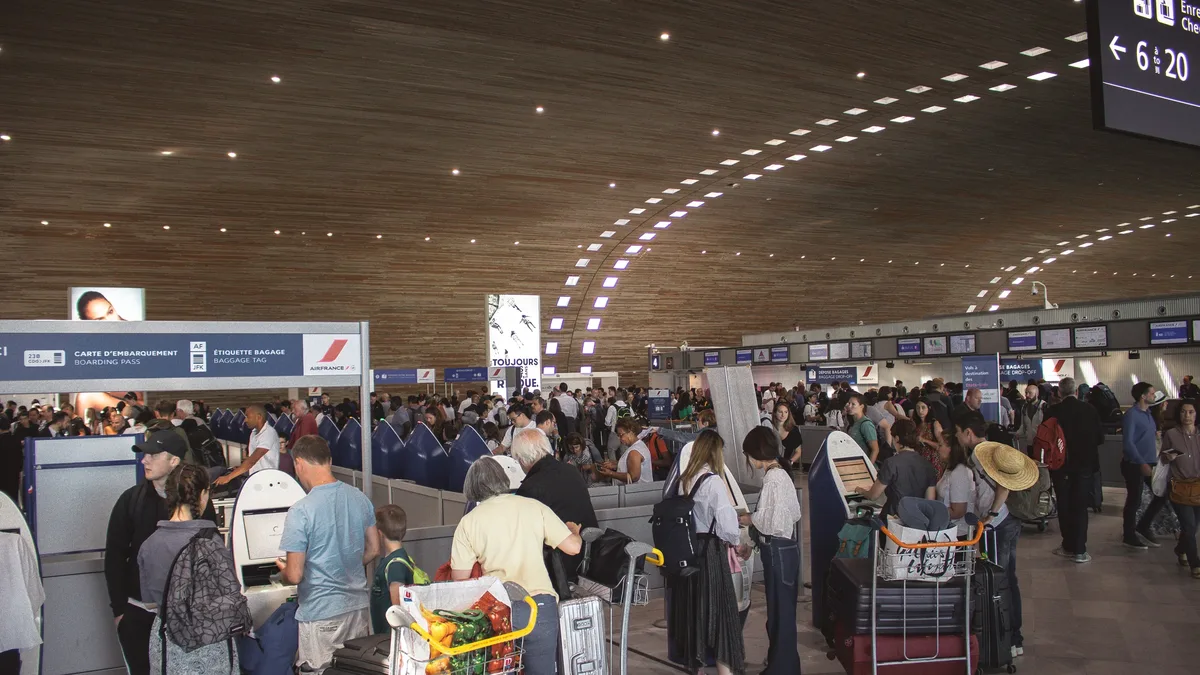
Growth rates diverged sharply based on airport size. The continent's largest hubs, those handling over 40 million passengers annually, grew just 1.3% in August. Istanbul Airport was the busiest European airport that month, welcoming 8.6 million passengers, a 3% increase. London Heathrow ranked second with 7.9 million passengers, but saw a 2.1% decline. Paris-Charles de Gaulle also declined, handling 6.9 million passengers, down 1.1%.
Other major hubs showed mixed results. Istanbul Sabiha Gökçen grew 9.5%, Madrid 4.9%, and Barcelona 4.5%. London Gatwick declined 3.4%, Amsterdam Schiphol was essentially flat with a 0.1% increase, Frankfurt declined 0.3%, and Munich declined 0.5%.
Smaller airport categories outperformed the giants. Airports handling 25 to 40 million passengers grew 0.8% in August. In this group, Malaga and London Stansted both grew 6.5%, Athens grew 3.7%, and Copenhagen grew 3.6%. Airports in the 10 to 25 million passenger bracket grew 4.8%, while those with 1 to 10 million passengers grew 5.2%.
Freight and movements data
Freight traffic across European airports showed a modest recovery, increasing 0.3% in July and 3% in August. Among Europe's ten largest freight airports, Istanbul recorded the strongest growth at 18.1% in August. Brussels grew by 8.6% and Amsterdam by 7.6%.
Aircraft movements increased 2.7% in July and 2.2% in August. The overall summer performance, however, comes with a cautious winter outlook. Jankovec noted that the geopolitical energy shock is likely to put further pressure on supply and demand, with airlines already tightening capacity and increasing air fares to mitigate rising jet fuel costs. The re-emerging cost-of-living crisis will test the resilience of demand, meaning a more uncertain outlook with renewed traffic risks and intensifying competitive pressures into the winter season for airports.