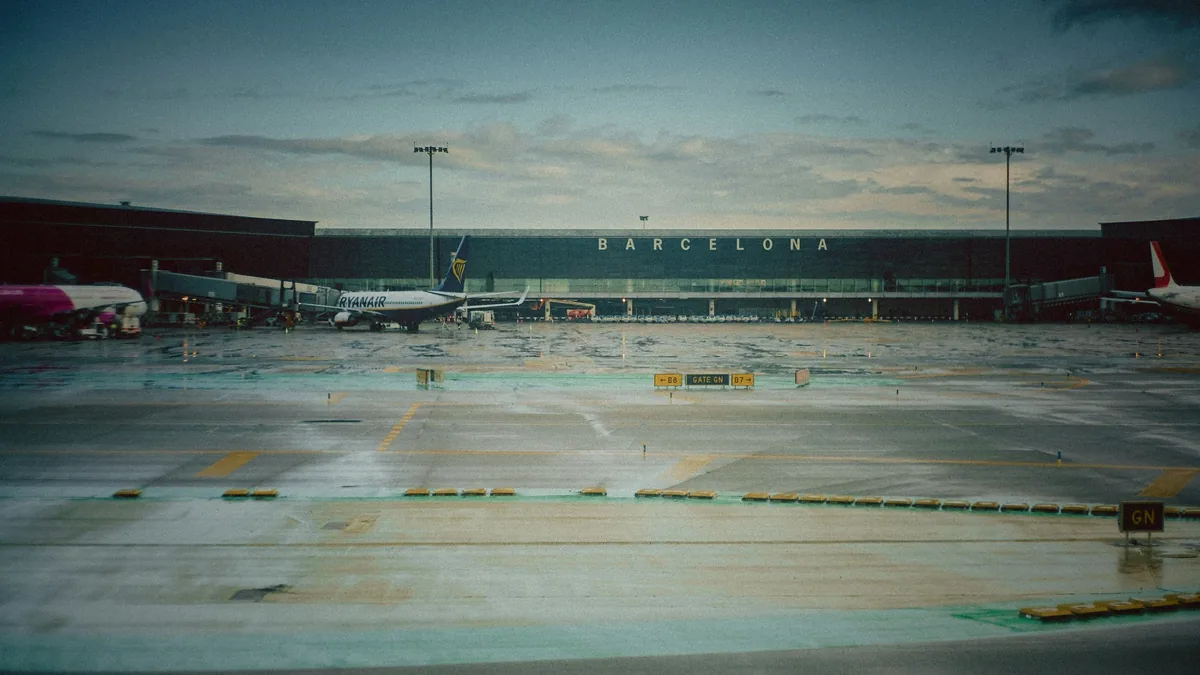
Bcn
| Country of origin | Spain |
|---|---|
| First created | Opened for regular flights in 1919 (aerodrome), major international terminal opened in 1992 |
| IATA code | BCN |
| Original use | Commercial passenger and cargo aviation hub |
| Terminals | Two main passenger terminals (T1 and T2), with T2 subdivided into areas (A, B, C) |
| Airlines served | Over 100 airlines (major hub for Vueling and other European carriers) |
| Getting there | Connected by metro, commuter train, bus, and major highway to Barcelona city centre |
| Passenger capacity | Serves over 50 million passengers annually (very large) |
Origin and history
Barcelona–El Prat Airport, commonly referred to as BCN, is located in Catalonia, Spain. Its origins trace back to the early 20th century when a simple airfield was established for military and recreational aviation. The first dedicated passenger terminal began operations in the late 1940s, marking its formal transition into a commercial airport. Significant expansion occurred in the 1960s to accommodate the rise of mass tourism to the Costa Brava and Barcelona itself. A major redevelopment was completed in the 1990s in preparation for the 1992 Summer Olympics hosted by the city. The airport's most substantial modern transformation occurred in the 2000s with the opening of a new Terminal 1, consolidating its status as a major European hub.
What it is for
Barcelona–El Prat Airport functions as the primary international gateway for the Catalonia region and the second-largest airport in Spain by passenger volume. Its core purpose is to facilitate scheduled commercial passenger flights for a wide array of airlines, including full-service, low-cost, and long-haul carriers. The airport serves as a crucial economic engine for northeastern Spain, handling cargo operations and supporting aviation-related industries. It is designed to manage the complete passenger journey, encompassing check-in, security screening, customs and immigration, retail and dining, aircraft boarding, and baggage reclaim. The infrastructure includes two main passenger terminals connected by a shuttle bus, along with extensive aircraft parking aprons and two parallel runways. Furthermore, it acts as a key hub for connecting traffic, particularly between European routes and intercontinental destinations.
Pros and cons
A primary advantage of BCN is its extensive route network, offering direct connections to a vast number of European cities and a growing selection of intercontinental destinations. The airport's modern Terminal 1 is generally well-equipped, spacious, and offers a reasonable selection of retail and food options post-security. Its main drawback is the significant distance and sometimes costly ground transportation into central Barcelona, with the train and metro not providing a direct link to Terminal 1. The layout can be inefficient, as the separation between Terminal 1 and Terminal 2 often requires a mandatory shuttle bus transfer, which is poorly signposted and adds unexpected time. Passengers frequently regret not allocating sufficient time for the often-lengthy passport control queues for non-Schengen flights and the lengthy walks to some remote boarding gates. A common mistake is underestimating the transit time between terminals, especially for self-connecting passengers or those with tight layovers, which can lead to missed flights.
Who it suits
This airport best suits passengers whose origin, destination, or final connection is Barcelona or the wider Catalonia region, for whom it is the most direct option. It is well-suited for travelers on point-to-point routes, especially within Europe, served by the many low-cost and full-service carriers based there. The airport suits transfer passengers whose itineraries are on a single ticket with ample scheduled connection time, allowing for the terminal transfer. It is less ideal for passengers with mobility issues or those with very short layovers on separate tickets, due to the distances involved and terminal separation. Business travelers appreciate the frequency of flights to major European economic centers, while leisure travelers benefit from the broad seasonal holiday route network. Ultimately, it suits travelers who prioritize route availability and flight frequency over the convenience of a quick or inexpensive transfer to Barcelona's city center.